Sea Glass Trinity Stitch Jar Cozy Free Pattern: A Mid-Century Crochet Jar Cover

Sea Glass Trinity Stitch Jar Cozy: A Mid-Century Crochet Jar Cover
Introduction
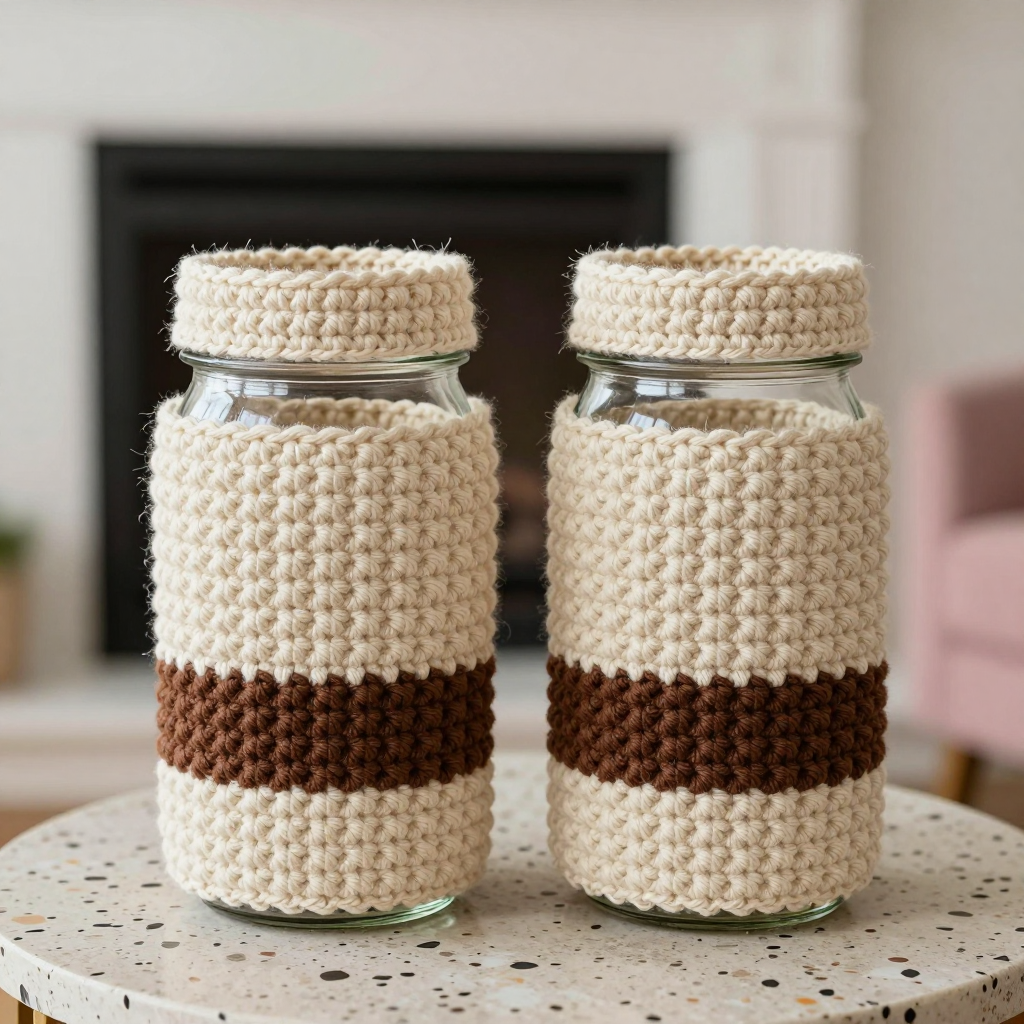
If you have ever wanted to make something beautiful but felt intimidated by fancy stitches, this Sea Glass Trinity Stitch Jar Cozy is the perfect first project for you. It is a simple, straight tube worked in the round, which means you only ever work on the outside of a circle and never have to turn your work or sew pieces together. The finished cozy looks like a little knitted sweater for a glass jar, with a dense, nubby texture that resembles tiny stars or sea glass pebbles, and it feels soft but sturdy in your hands. Striped in soft aqua and white, it slips over a standard 16 oz jar and instantly gives it a mid-century modern, ocean-inspired look. Best of all, it uses only two easy stitches, single crochet and a cluster, so you can finish it in an evening while watching TV.
Materials Needed
- Yarn: Worsted weight (Category 4) cotton or cotton-blend yarn, approximately 90–110 yards total. You will need about 55 yards of Color A (soft aqua) and about 45 yards of Color B (white). Cotton is recommended because it is sturdy, washable, and shows the stitch texture beautifully.
- Crochet hook: Size H/8 (5.0 mm).
- Stitch markers: At least 2, to mark the first stitch of each round.
- Tapestry needle: A blunt-tipped needle with a large eye for weaving in yarn ends.
- Scissors: Any small sharp scissors for cutting yarn.
- Finished size: Fits a standard 16 oz (473 ml) glass jar with a 3-inch (7.5 cm) diameter body. The cozy measures approximately 9.5 inches (24 cm) in circumference (unstretched) and 3.5 inches (9 cm) tall, including the rim. The trinity stitch is stretchy, so the cozy hugs the jar with slight negative ease (it stretches a little to fit snugly).
Abbreviations and Beginner Glossary
- ch – chain. Make a loop with the yarn, pull the working yarn through the loop, and repeat. Each loop you pull through is one chain stitch. Chains form the foundation you build on.
- sc – single crochet. Insert your hook into the stitch, yarn over (wrap the yarn around the hook), pull up a loop (you now have 2 loops on the hook), yarn over again, and pull through both loops. One single crochet made.
- sc3tog – single crochet 3 stitches together. Insert your hook into the next stitch, yarn over, pull up a loop (2 loops on hook). Repeat this in the next stitch (3 loops on hook), then repeat in the next stitch (4 loops on hook). Yarn over and pull through all 4 loops at once. This decreases three stitches into one and creates a little bump.
- trinity cluster – (sc, ch 1, sc) all worked into the same stitch. In other words, make one single crochet, then one chain, then another single crochet, all in the same spot. This creates a small star-like cluster.
- sl st – slip stitch. Insert your hook into the stitch, yarn over, and pull the yarn through both the stitch and the loop on your hook at the same time. This joins rounds without adding height.
- st(s) – stitch(es).
- A – Color A (soft aqua).
- B – Color B (white).
- yarn over – wrap the working yarn around your hook from back to front.
- right side – the outside of the cozy that will show when it is on the jar.
- wrong side – the inside of the cozy that touches the glass.
Gauge
13 stitches and 12 rounds = 4 inches (10 cm) in trinity stitch pattern, worked in the round.
Gauge matters because it tells you how big your finished cozy will be. If your stitches are looser than the pattern, the cozy will be too big and slide off the jar. If your stitches are tighter, it will be too small to stretch over the glass. To check your gauge, crochet a small practice swatch: chain 31, join into a ring, and work Rounds 1–4 of the pattern. Measure a 4-inch section in the middle. If you have more than 13 stitches in 4 inches, your stitches are too tight; go up one hook size. If you have fewer than 13 stitches, your stitches are too loose; go down one hook size. Wash and dry your swatch the way you plan to wash the cozy, because cotton can shrink or grow slightly.
Beginner Tips Before You Start
- Use stitch markers. Place a marker in the first stitch of every round. Because you work in a continuous spiral-like circle, it is easy to lose track of where a round begins. Move the marker up each round.
- Do not pull the yarn too tight. Beginners often tug the yarn after each stitch. Keep your tension relaxed so the trinity clusters stay puffy and the cozy stays stretchy enough to fit over the jar.
- Count your stitches at the end of every round. You should always have 31 stitches in the rim rounds and the same number of clusters and sc3tog in the body rounds. Counting takes ten seconds and saves you from ripping out rows later.
- Work your clusters into the chain-1 spaces, not the single crochets. This is the most important rule of trinity stitch. The cluster and the sc3tog always go into the little holes (chain-1 spaces) from the previous round. If you work into the solid stitches instead, the texture will disappear.
- Change colors on the last yarn over of the joining slip stitch. This hides the color change neatly. Drop Color A, pick up Color B, and pull it through to finish the slip stitch.
- Keep your beginning chain untwisted. Before you join the chain into a ring, lay it flat on the table and make sure all the chains face the same way. A twisted ring cannot be fixed later.
Step-by-Step Instructions
Set-Up and Foundation
Set-Up: With Color A, ch 31. Being careful not to twist the chain, join with a sl st to the first ch to form a ring. (31 ch)
Body (Trinity Stitch)
Round 1 (A): Ch 1 (this does not count as a stitch). Sc in the same ch as the join and in each ch around. Join with a sl st to the first sc. (31 sc)
Round 2 (A): Ch 1. Sc in the first sc. *Sc3tog over the next 3 sc, then make a trinity cluster (sc, ch 1, sc) in the next sc; repeat from * around, ending with sc3tog over the last 3 sc. Join with a sl st to the first sc. (10 trinity clusters, 10 sc3tog, plus 1 edge sc)
Round 3 (A): Ch 1. Trinity cluster in the first sc. *Sc3tog in the next ch-1 space, trinity cluster in the next ch-1 space; repeat from * around, ending with sc3tog in the last ch-1 space. Join with a sl st to the first sc. (10 trinity clusters, 10 sc3tog)
Round 4 (B): Change to Color B by pulling B through on the final yarn over of the joining sl st. Ch 1. Trinity cluster in the first sc. *Sc3tog in the next ch-1 space, trinity cluster in the next ch-1 space; repeat from * around, ending with sc3tog in the last ch-1 space. Join with a sl st to the first sc. (10 trinity clusters, 10 sc3tog)
Round 5 (B): Repeat Round 4 once more in Color B. (10 trinity clusters, 10 sc3tog)
Round 6 (A): Change back to Color A. Repeat Round 4. (10 trinity clusters, 10 sc3tog)
Round 7 (A): Repeat Round 4 once more in Color A. (10 trinity clusters, 10 sc3tog)
Round 8 (B): Change to Color B. Repeat Round 4. (10 trinity clusters, 10 sc3tog)
Round 9 (B): Repeat Round 4 once more in Color B. (10 trinity clusters, 10 sc3tog)
Round 10 (A): Change to Color A. Repeat Round 4. (10 trinity clusters, 10 sc3tog)
Round 11 (A): Repeat Round 4 once more in Color A. Do not fasten off. (10 trinity clusters, 10 sc3tog)
Rim (Single Crochet)
Round 12 (A): Ch 1. Sc in each st and each ch-1 space around. Join with a sl st to the first sc. (31 sc)
Round 13 (A): Ch 1. Sc in each sc around. Join with a sl st to the first sc. Fasten off Color A, leaving a 6-inch (15 cm) tail. (31 sc)
Color Sequence Summary
- Rounds 1–3: Color A
- Rounds 4–5: Color B
- Rounds 6–7: Color A
- Rounds 8–9: Color B
- Rounds 10–11: Color A
- Rounds 12–13: Color A (rim)
Assembly and Finishing
Weaving in ends: Thread each yarn tail onto your tapestry needle. Turn the cozy wrong side out. Working on the inside, weave the needle in and out through the back of several stitches, going in one direction, then reverse direction for an inch to lock the tail in place. Trim the yarn close to the fabric. Do this for every tail, including the color-change tails.
Blocking: Turn the cozy right side out. Gently steam-block the trinity stitch flat without pressing the iron onto the fabric. Hold a steam iron an inch or two above the surface and let the steam relax the stitches, then pat the cozy into shape with your hands and let it dry completely. This opens up the nubby texture and evens out the stripes.
Fitting: Slip the cozy over the jar. The stretchy trinity fabric will grip the glass. The single-crochet rim sits at the top edge of the cozy, and the bottom edge rests just above the jar base. If the cozy feels too loose, gently steam and pat it slightly narrower; if it is too tight, steam and stretch it gently over the jar while warm.
Pro Tips and Variations
- Change the color story. Swap the aqua and white for any two colors you love: sage green and cream for a woodland look, mustard and oatmeal for a vintage feel, or two shades of the same color for a subtle tonal stripe. Keep the same round counts so the size stays the same.
- Adjust the size. The pattern is worked over a multiple of 3 stitches plus 1. To fit a wider jar, add 3 chains to your starting chain for every extra inch of circumference. To make it taller, add extra two-round stripes in the body before the rim. Always finish with the two single-crochet rim rounds.
- Substitute the yarn. Cotton is best, but a cotton-acrylic blend or a smooth DK weight held double will also work. Always crochet a gauge swatch with your substitute yarn, because different fibers stretch differently and can change the finished size.
- Add a hanging loop. After Round 13, ch 12, then sl st back into the same stitch to form a loop, and fasten off. This lets you hang the cozy on a hook when it is not on the jar.