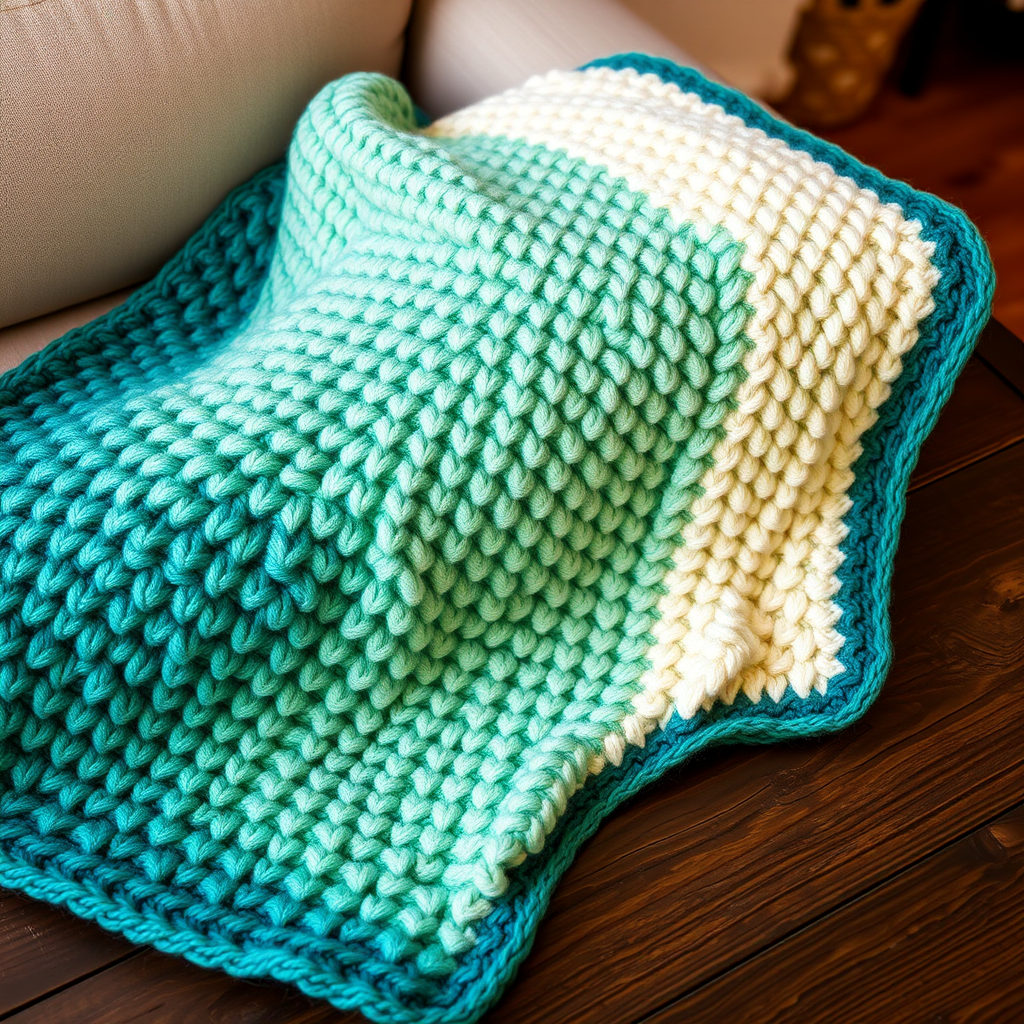
The Dune Drift Chevron Blanket Free Pattern – A Knitted Oasis of Sand and Sage

The Dune Drift Chevron Blanket: A Knitted Oasis of Sand and Sage
Wrap yourself in the undulating rhythm of desert dunes with this modern chevron blanket, knitted in a palette of warm sand, soft sage, and dusty rose. The ripple stitch creates a mesmerizing, textured landscape that is both cozy and sculptural. This free pattern is perfect for intermediate knitters looking to create a statement piece for their home, and with our detailed step-by-step instructions, even confident beginners can tackle this rewarding project. The result is a deeply textured, artisanal throw that brings a touch of calm, organic boho style to any space.
Materials Needed
Before you begin your knitting journey, gather the following materials. Having everything ready will make the process smooth and enjoyable.
- Yarn: Worsted weight yarn in 3 colors:
- Color A (Sand) – 800g (approximately 1,600 yards)
- Color B (Sage) – 600g (approximately 1,200 yards)
- Color C (Dusty Rose) – 400g (approximately 800 yards)
- Needle: US 9 (5.5mm) circular knitting needle, 32-inch or longer (the long cord is essential to accommodate the large number of stitches).
- Notions: Stitch markers (optional but helpful), tapestry needle for weaving in ends, and blocking pins.
Gauge
16 stitches and 20 rows = 4 inches in stockinette stitch (after blocking). Always knit a gauge swatch to ensure your blanket matches the finished dimensions. Adjust your needle size if necessary to achieve the correct gauge.
Step-by-Step Instructions
Follow these detailed instructions carefully. The pattern is worked flat in one piece, back and forth in rows. The chevron ripple pattern is created by alternating increases (yarn overs) and decreases (k2tog, ssk) in a repeating sequence.
Finished Size
Approximately 50 inches wide x 65 inches long (blocked).
Special Stitches
- K2tog (Knit Two Together): Insert the right needle into two stitches on the left needle as if to knit, and knit them together. This creates a right-leaning decrease.
- SSK (Slip, Slip, Knit): Slip the next two stitches knitwise, one at a time, to the right needle. Insert the left needle into the front of these two slipped stitches and knit them together. This creates a left-leaning decrease.
- Yo (Yarn Over): Bring the yarn to the front of the work, then over the right needle to the back, creating a new loop on the needle. This is an increase that creates a small hole, forming the "valley" of the chevron.
Pattern Notes
- The blanket is worked flat in one piece, back and forth in rows.
- Use a long circular needle to accommodate the large number of stitches (201 stitches).
- Change colors according to the stripe sequence below. You can carry the yarn up the side of the work or weave in ends at each color change. Carrying the yarn creates a neat selvedge edge.
- The stitch count remains constant at 201 stitches throughout the pattern. Each row of the ripple pattern uses 14 repeats of the 14-stitch pattern, plus 1 edge stitch (K1) at the beginning and end.
Stripe Sequence
This is the rhythm of colors that creates the desert landscape effect:
- Work 10 rows in Color A (Sand)
- Work 8 rows in Color B (Sage)
- Work 6 rows in Color C (Dusty Rose)
- Repeat this sequence throughout the blanket, ending with 10 rows of Color A.
Getting Started: The Foundation
Foundation Row (Wrong Side): With Color A (Sand), cast on 201 stitches loosely. A long-tail cast-on is recommended for a stretchy, neat edge.
Row 1 (Right Side): Knit all stitches. This creates a smooth base for the ripple pattern.
Row 2 (Wrong Side): Purl all stitches.
Establishing the Ripple Pattern
Row 3 (Right Side – Establish Ripple Pattern): This is the magic row that creates the chevrons. Work as follows:
K1, *k2tog, k2tog, k1, yo, k1, yo, k1, yo, k1, yo, k1, k2tog, k2tog, k1; repeat from * to end.
Let's break this down. The pattern repeat is 14 stitches. You will repeat this sequence 14 times across the row, with a single K1 at the beginning and end of the row. The two k2tog at the start and end of the repeat create the descending and ascending slopes of the chevron, while the four yarn overs in the middle create the peak.
Row 4 (Wrong Side): Purl all stitches. This row is the same for every repeat.
Rows 5-10: Repeat Rows 3 and 4 three more times. You will have completed a total of 10 rows in Color A (Sand).
Color Changes and Continuing the Pattern
Color Change to Color B (Sage): At the end of Row 10, cut Color A, leaving a 6-inch tail, and join Color B.
Rows 11-18: Repeat Rows 3 and 4 four times. This completes 8 rows in Color B (Sage).
Color Change to Color C (Dusty Rose): At the end of Row 18, cut Color B and join Color C.
Rows 19-24: Repeat Rows 3 and 4 three times. This completes 6 rows in Color C (Dusty Rose).
Continuing the Stripe Sequence
Now that you have established the rhythm, continue the pattern:
- Repeat the 10-row (Color A), 8-row (Color B), 6-row (Color C) sequence until the blanket measures approximately 63 inches from the cast-on edge, ending with a complete Color C (Dusty Rose) stripe. This ensures the pattern is symmetrical.
Final Stripe and Bind Off
Final Stripe: Work 10 rows in Color A (Sand). This means repeating Rows 3 and 4 five times.
Bind Off (Right Side): With Color A, knit all stitches loosely. On the next row (Wrong Side), bind off by knitting the first stitch, knitting the next stitch, and passing the first stitch over the second. Continue this process across the row. Cut the yarn, leaving a 6-inch tail, and pull it through the last loop to secure.
Finishing: Weave in all loose ends using a tapestry needle. Be sure to weave in ends securely on the wrong side of the blanket.
Blocking: The Final Transformation
Blocking is essential for this pattern to open up the yarn overs and create crisp, defined chevron peaks and valleys.
- Soak the blanket in lukewarm water with a gentle wool wash for 20 minutes. Do not agitate.
- Gently squeeze out excess water. Do not wring or twist the fabric, as this can felt the wool.
- Lay the blanket flat on a clean, dry towel. Roll the towel up with the blanket inside to absorb more water.
- Lay the blanket flat on a blocking mat or a clean, dry towel on the floor.
- Shape the blanket to the finished dimensions (50 inches wide x 65 inches long).
- Pin the points of the chevrons to create crisp peaks and valleys. Use blocking pins to secure each point, gently stretching the fabric to open up the stitch pattern.
- Allow the blanket to dry completely, which may take 24-48 hours. Once dry, remove the pins and enjoy your beautiful, textured masterpiece.
Your Dune Drift Chevron Blanket is now complete. Drape it over a rustic wooden bench, a cozy armchair, or the foot of your bed. The interplay of sand, sage, and dusty rose will bring a serene, organic warmth to your home, a true knitted oasis you created with your own hands.