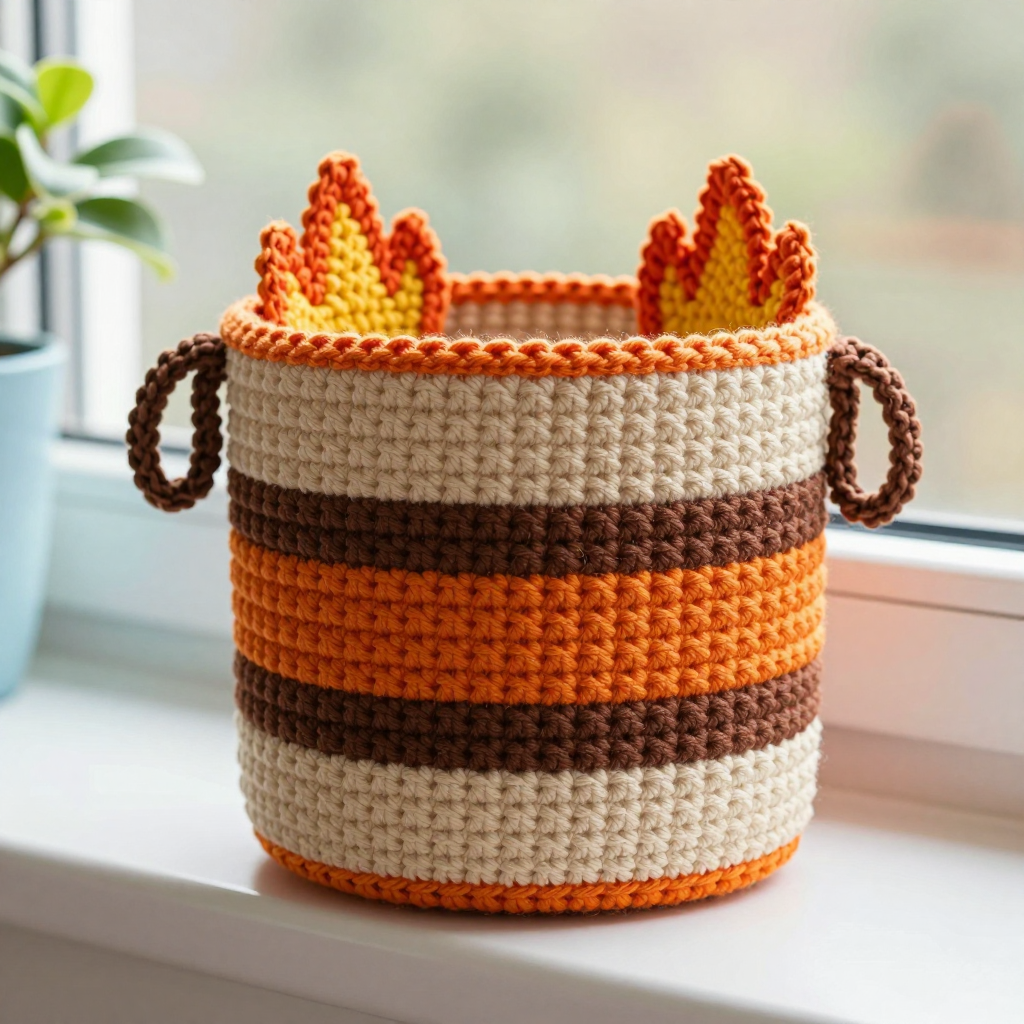
Color Wheel Yarn Cosy Free Knitting Pattern: Rainbow Brights Colorwork Tube

Color Wheel Yarn Cosy: A Rainbow Tube for Complete Beginners
If you have never held knitting needles before, this is the perfect first project to fall in love with. The Color Wheel Yarn Cosy is a simple straight tube worked in plain knit stitches, so you only ever learn one stitch to make the whole thing. What makes it special is the color: seven bright rainbow segments that change every six rounds, giving you a cheerful, mid-century modern look with almost no effort. The finished cosy is a smooth, even cylinder about 12 inches (30.5 cm) around and 5 inches (12.5 cm) tall, with slightly rolled edges and clean, flat color joins that show no knots on the outside. Slip it over a yarn cake or ball and it keeps your yarn tidy, tangle-free, and pretty enough to leave out on the table.
Materials Needed
- Yarn: Worsted weight (CYC 4) smooth wool or wool-blend yarn in 7 rainbow brights: red, orange, yellow, green, blue, indigo, and violet. You need approximately 15–20 yd (14–18 m) of each color, about 105–140 yd (96–128 m) total.
- Needles: US 7 (4.5 mm) circular needle, 16 in (40 cm) long, or the size you need to get gauge. Circular needles are used so the tube can be worked in the round; you will not join the ends.
- Stitch marker: One, to mark the beginning of each round.
- Tapestry needle: A blunt-tipped needle with a large eye, for weaving in yarn ends.
- Scissors: Any sharp pair for cutting yarn.
- Finished size: Circumference approximately 12 in (30.5 cm), unstretched, to fit a standard 3.5–4 oz (100–113 g) yarn cake or ball up to about 4.5 in (11.5 cm) in diameter. Height approximately 5 in (12.5 cm).
Abbreviations and Beginner Glossary
- st / sts – stitch / stitches. A stitch is one loop of yarn on your needle.
- rnd / rnds – round / rounds. One complete trip around the circle of stitches.
- k – knit. Insert the right needle into the front of the stitch from left to right, wrap the working yarn around the right needle, pull the new loop through, and slide the old stitch off the left needle.
- p – purl. Insert the right needle into the front of the stitch from right to left, wrap the yarn around, pull the loop through, and slide the old stitch off. (Used only in the optional ribbed edge.)
- CO – cast on. The way you create your first row of loops on the needle.
- BO – bind off. The way you finish the edge so the stitches cannot unravel.
- stockinette stitch in the round – knit every single stitch on every round. This makes the smooth, V-shaped texture you see on the outside of the cosy.
- long-tail cast-on – a stretchy, tidy cast-on. Make a slip knot, hold the yarn with a long tail over your thumb and the working yarn over your finger, then scoop loops onto the needle. Any beginner cast-on works if you prefer.
- join to work in the round – after casting on, slide the stitches so the first and last cast-on stitches meet, make sure the edge is not twisted, and knit the first stitch to connect the circle.
- carry the yarn – leave the old color hanging on the inside of the tube instead of cutting it, so you can pick it up again later.
- twist the new color around the old – before knitting the first stitch in the new color, cross the new yarn over the old yarn once. This locks the colors together so no hole or gap forms.
- weave in ends – thread the yarn tail onto a tapestry needle and run it back and forth through the inside of the fabric so it disappears.
- block – dampen the finished piece and pat it into shape so the stitches even out.
Gauge
20 sts and 26 rnds = 4 in (10 cm) in stockinette stitch in the round, blocked.
Gauge means how many stitches and rounds fit into a square of fabric. It matters because it decides the final size: if your stitches are bigger than this, the cosy will be too loose and may slide off the yarn cake; if they are smaller, it will be too tight to fit. To check, cast on about 30 stitches with your chosen yarn and needles, knit in the round for about 4 inches (10 cm), then lay the swatch flat without stretching it. Count the stitches across 4 inches and the rounds up 4 inches. If you have more than 20 stitches, go up a needle size; if you have fewer, go down a needle size. Wash and dry your swatch the way you plan to wash the cosy, because wool can change size after blocking.
Beginner Tips Before You Start
- Use the stitch marker every round. Slip it from the left needle to the right needle at the start of each round. It tells you exactly where each round begins so your six-round color segments stay even.
- Do not pull the yarn too tight. Keep your stitches relaxed and even. Tight stitches make the tube stiff and hard to slide onto a yarn cake.
- Check for twists before you join. After casting on, lay the needle flat and make sure all the cast-on bumps face the same way along the inside of the circle. A twist here cannot be fixed later.
- Change colors on the same side every time. Always twist the new color around the old one at the beginning of the round, on the inside of the tube, so the joins stay hidden.
- Count your stitches after each color change. You should always have 60 stitches. Counting takes ten seconds and saves hours of fixing.
- Keep the carried strands loose. Let the old color rest gently against the inside of the tube. If you pull it tight, the tube will pucker at the color change.
Step-by-Step Instructions
Set-Up
Set-Up Row: With red, cast on 60 sts using the long-tail cast-on. Join to work in the round, being careful not to twist the stitches. Place a stitch marker to mark the beginning of the round. (60 sts)
Body
The body is worked as a straight tube in stockinette stitch: knit every stitch on every round. Each color segment is 6 rounds tall, and there are 7 segments, giving 42 rounds total.
Rounds 1–6 (Red segment): Knit all stitches. (60 sts)
Change to orange: Carry red up the inside, twist orange around red, and knit the first stitch with orange.
Rounds 7–12 (Orange segment): Knit all stitches. (60 sts)
Change to yellow: Carry orange up the inside, twist yellow around orange, and knit the first stitch with yellow.
Rounds 13–18 (Yellow segment): Knit all stitches. (60 sts)
Change to green: Carry yellow up the inside, twist green around yellow, and knit the first stitch with green.
Rounds 19–24 (Green segment): Knit all stitches. (60 sts)
Change to blue: Carry green up the inside, twist blue around green, and knit the first stitch with blue.
Rounds 25–30 (Blue segment): Knit all stitches. (60 sts)
Change to indigo: Carry blue up the inside, twist indigo around blue, and knit the first stitch with indigo.
Rounds 31–36 (Indigo segment): Knit all stitches. (60 sts)
Change to violet: Carry indigo up the inside, twist violet around indigo, and knit the first stitch with violet.
Rounds 37–42 (Violet segment): Knit all stitches. (60 sts)
Optional firm top edge: Instead of knitting Round 42 plain, work it as a knit 1, purl 1 rib round: knit the first stitch, purl the next, and repeat around. (60 sts)
Finishing the Tube
Bind-off round: Bind off all 60 stitches loosely in violet. To bind off, knit the first two stitches, then lift the first stitch over the second and off the needle; knit the next stitch and lift the previous stitch over it again. Repeat until one stitch remains, then cut the yarn and pull the tail through the last loop. (0 sts on needle)
Assembly and Finishing
Weave in the ends. Thread each yarn tail onto the tapestry needle. Turn the cosy inside out and run the needle back and forth through the backs of several stitches in one direction, then turn and run through a few stitches in the other direction. This traps the tail securely without tying a knot. Use the carried strands inside the tube to secure any loose tails the same way.
Check the joins. Look at each color change from the outside. The joins should be flat and closed, with no gap or hole. If you see a small gap, use the tapestry needle to pull the nearby stitches together gently from the inside.
Block gently. Soak the cosy in cool water for about 15 minutes, squeeze it gently in a towel without wringing, then lay it flat and smooth it into a neat cylinder about 12 in (30.5 cm) around and 5 in (12.5 cm) tall. Pat the edges straight and let it dry completely away from direct heat.
Use it. Slip the cosy over a yarn cake or ball, centering the cake inside the tube so the yarn feeds evenly from the center or the outside.
Pro Tips and Variations
- Change the color order. Work the same seven segments in any order you like, or use just three colors repeated for a bolder, simpler look. Keep each segment 6 rounds tall so the height stays the same.
- Make it taller or shorter. Add or remove 6-round segments in any colors. Each segment adds about 0.9 in (2.3 cm) of height at this gauge, so two extra segments make a cosy about 7 in (17.5 cm) tall.
- Substitute yarn. Any smooth worsted weight (CYC 4) wool or wool blend works. Avoid fluffy or fuzzy yarns for your first try, because they hide the stitches and make counting harder.
- Adjust the size. For a larger yarn cake, cast on 72 sts instead of 60 and keep the same 6-round segments; the tube will be about 14.5 in (37 cm) around. Check your gauge first so the fit stays right.