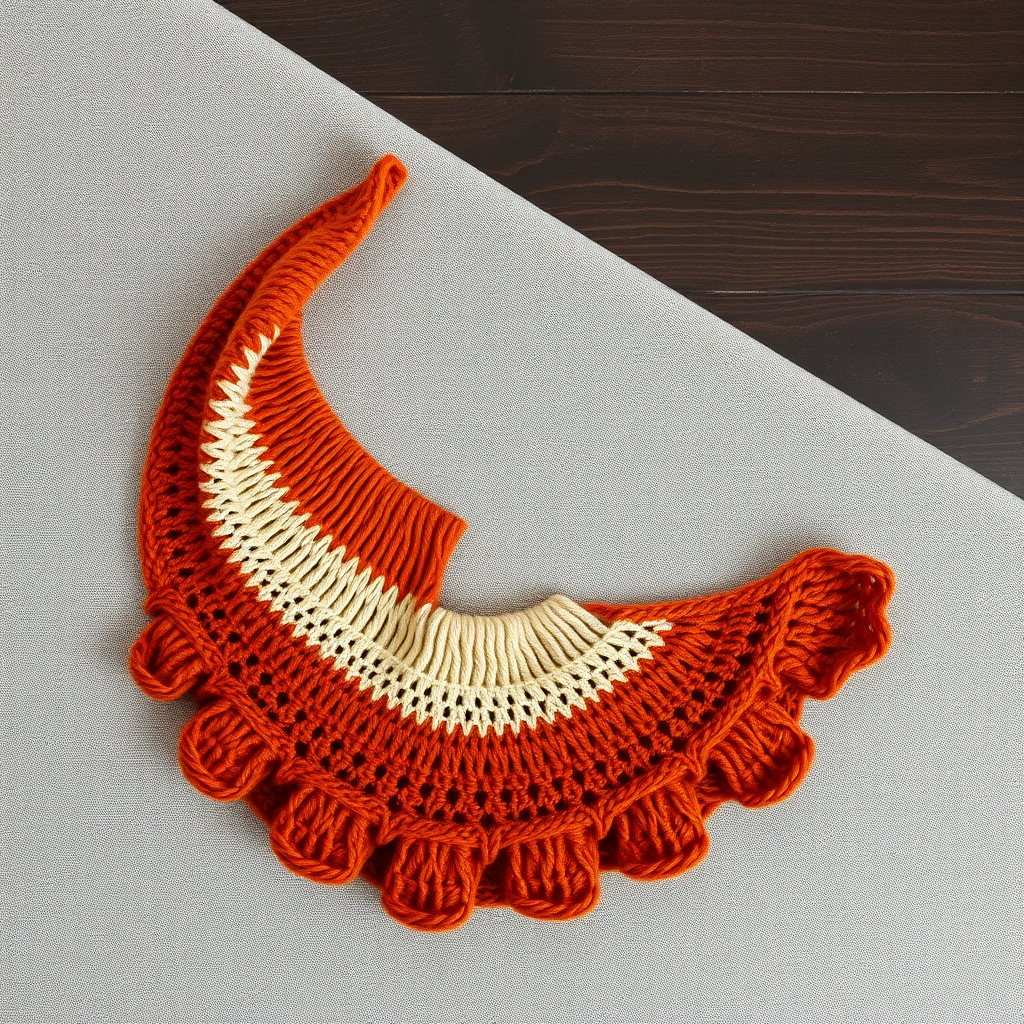
The Whispering Dunes Crescent Shawl: A Free Knitting Pattern for a Textured, Modern Wrap

Introducing the Whispering Dunes Crescent Shawl
Wrap yourself in the shifting sands of the desert with this crescent-shaped shawl, featuring a mesmerizing interplay of garter stitch ridges and delicate lace drops. The soft, gradient yarn creates a stunning ombre effect that mimics the dunes at twilight. This modern, textured wrap is perfect for adding a touch of elegance to any outfit, and the free pattern below makes it accessible for knitters of all skill levels.
Materials Needed
To create your own Whispering Dunes Crescent Shawl, gather the following materials:
- Yarn: Fingering weight yarn (approx. 400-450 yards) in a gradient or tonal colorway (e.g., 'Sand Dune' by Malabrigo Sock). Sample uses 1 skein.
- Needle: US 6 (4.0 mm) 32-inch circular knitting needle (to accommodate the increasing stitch count).
- Other: Tapestry needle for weaving in ends, blocking pins and mats.
Gauge
20 stitches and 28 rows = 4 inches in garter stitch after blocking. Achieving gauge is important for the final size and drape, so take time to check your tension.
Step-by-Step Instructions
This shawl is worked from the top center outwards, increasing at the center and edges to form a crescent shape. Follow these detailed steps carefully.
Abbreviations
- k = knit
- k2tog = knit two together
- kfb = knit front and back (increase)
- yo = yarn over
- sl1 = slip one stitch purlwise
- psso = pass slipped stitch over
Pattern
Cast on 3 stitches.
Garter Stitch Base
Row 1 (WS): k3.
Row 2 (RS): kfb, k1, kfb. (5 stitches)
Row 3: k5.
Row 4: kfb, k3, kfb. (7 stitches)
Row 5: k7.
Row 6: kfb, k5, kfb. (9 stitches)
Row 7: k9.
Begin Lace Section
Row 8 (RS): kfb, k2, yo, k2tog, k1, yo, k2tog, kfb. (11 stitches)
Row 9 (WS): k11.
Row 10: kfb, k4, yo, k2tog, k1, yo, k2tog, kfb. (13 stitches)
Row 11: k13.
Row 12: kfb, k6, yo, k2tog, k1, yo, k2tog, kfb. (15 stitches)
Row 13: k15.
Row 14: kfb, k8, yo, k2tog, k1, yo, k2tog, kfb. (17 stitches)
Row 15: k17.
Row 16: kfb, k10, yo, k2tog, k1, yo, k2tog, kfb. (19 stitches)
Row 17: k19.
Row 18: kfb, k12, yo, k2tog, k1, yo, k2tog, kfb. (21 stitches)
Row 19: k21.
Row 20: kfb, k14, yo, k2tog, k1, yo, k2tog, kfb. (23 stitches)
Row 21: k23.
Row 22: kfb, k16, yo, k2tog, k1, yo, k2tog, kfb. (25 stitches)
Row 23: k25.
Row 24: kfb, k18, yo, k2tog, k1, yo, k2tog, kfb. (27 stitches)
Row 25: k27.
Repeat Lace Section with Staggered Effect
Repeat the Lace Section (Rows 8-25) two more times, but on the second repeat, the lace pattern will shift slightly to create a staggered effect. Instead of starting the lace at row 8, start at row 10 (kfb, k4, yo, k2tog, k1, yo, k2tog, kfb) and continue through row 25. On the third repeat, start at row 12 (kfb, k6, yo, k2tog, k1, yo, k2tog, kfb) and continue through row 25.
Final Garter Section
Work 6 rows of garter stitch (knit every row), continuing the increases at the beginning and end of each RS row (kfb at start and end).
Bind Off Loosely
Knit 2 stitches, *insert left needle into the front of the two stitches on the right needle and knit them together through the back loop, knit 1 stitch, repeat from * until all stitches are bound off.
Finishing
Weave in ends. Block the shawl by soaking in lukewarm water, gently squeezing out excess, and pinning to shape, stretching the lace points slightly. Allow to dry completely. This step is crucial for opening up the lace pattern and achieving the beautiful crescent shape.